Small Apartment Interior Design Ideas in Delhi — Make Every Inch Count in 2026
Living in a small apartment in Delhi? Here are practical interior design ideas that actually work — ones that make your home feel bigger, more comfortable, and easier to live in every day.
Honestly, almost every apartment in Delhi has the same problem. Whether you’re in a 1BHK in Dwarka, a 2BHK in Janakpuri, or a small flat somewhere in Noida — the first thing people say is the same: “space nahi hai.”
But here’s something I’ve noticed after years of working on homes across Delhi NCR. The problem is rarely the size of the flat. I’ve seen 650 sq ft apartments that felt calm, open, and comfortable to live in. And I’ve seen 1000 sq ft flats where you felt suffocated the moment you walked in.
The size was never the real issue. It was always the decisions made inside — what furniture was bought, where it was placed, how the light came in, how storage was handled.
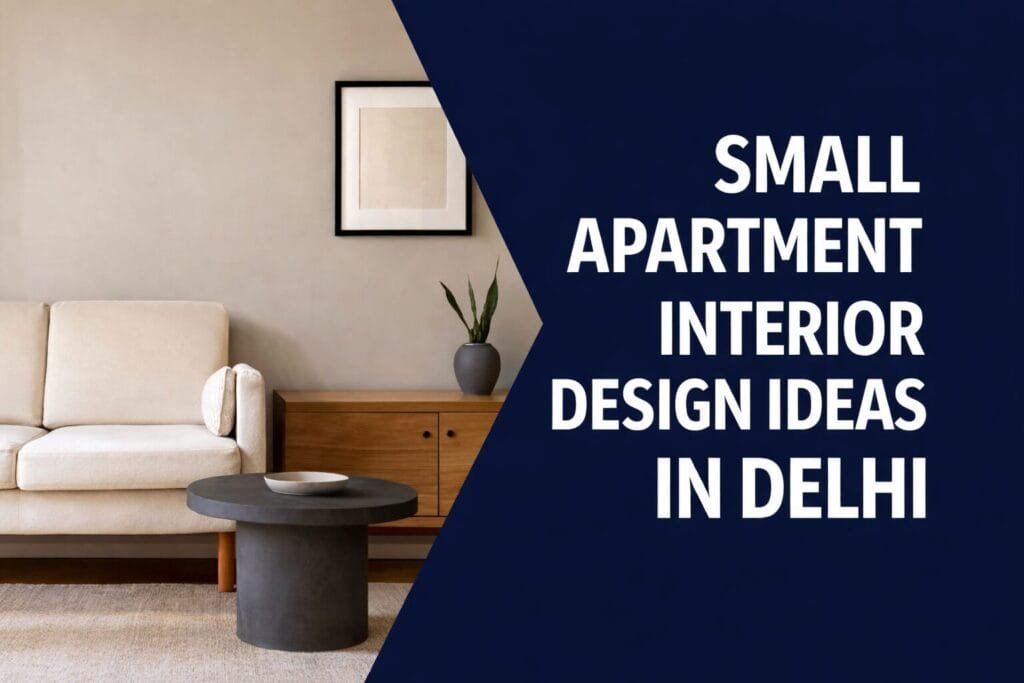
So if you’re planning to redo your small apartment in Delhi — or just trying to make it feel better without spending a lot — this guide is written for exactly that situation. No fancy ideas from international 3design magazines that have nothing to do with how we actually live in India. Just practical things that work in real Delhi homes, with real budgets, and real families.
Why Small Apartment Design in Delhi Is a Unique Challenge
Delhi homes have their own personality. Joint families mean more people sharing fewer rooms. Festivals mean you need space for guests every few months. Summers are brutal, so ventilation and cooling matter. And most builder floors or society apartments come with fixed layouts that aren’t always the most practical.
Add to that the fact that most homeowners in West Delhi, Dwarka, and similar areas are working with standard 2BHK layouts — roughly 850 to 1100 sq ft — and you start to understand why smart design matters so much here.
The goal isn’t to make a small flat look large in photos. The goal is to make it work well for real daily life.
Start With Decluttering Before You Design Anything
This sounds obvious. It isn’t, because most people skip it.
Before you think about furniture or colour palettes, go through everything you own and ask one honest question: do I actually use this? In small apartments, every object that doesn’t earn its place takes up visual and physical space. A cluttered room will always feel small, no matter how well it’s designed.
Once you’ve cleared out what you don’t need, you’ll often find the apartment already feels a little bigger. Then you design on top of that.
Use Furniture That Does More Than One Job
This is probably the single most effective principle for small apartment living.
A bed with deep storage drawers underneath eliminates the need for a separate chest of drawers. A sofa with built-in storage handles extra linen, cushions, or seasonal items. A foldable dining table that sits against the wall and opens up when needed saves you significant floor space in a small kitchen-dining area.
In Delhi homes, I’ve seen wall-mounted foldable study tables work brilliantly in children’s rooms where floor space is precious. Murphy beds — beds that fold up into the wall — are still underused in India but are genuinely practical for studio apartments or guest rooms that double as home offices.
The principle is simple: every large piece of furniture in a small home should ideally serve two purposes. If it only does one thing, think about whether something smarter could replace it.
Rishabh Designs & Interior specialises in custom furniture solutions designed specifically for compact Delhi NCR homes — where every centimetre of space is planned with purpose.
Vertical Space Is Free — Use It
Most homeowners think horizontally. They think about floor space, about where to put the sofa, where the bed goes. But in a small apartment, your walls are some of your most valuable real estate.
Floor-to-ceiling wardrobes look built-in and sophisticated, and they store significantly more than standard-height ones. Wall-mounted shelves in the living room replace the need for a bulky bookcase on the floor. Kitchen cabinets that go all the way to the ceiling — instead of stopping at standard height with a dusty gap above — add a surprising amount of storage.
In one Janakpuri apartment we worked on, the homeowner had a tiny bedroom with almost no storage. By designing a full-height wardrobe across one complete wall, we created enough storage for two people without touching the floor plan at all. The room didn’t shrink — it felt more organised and, oddly, larger.
Colours and Light: The Easiest Way to Change How a Room Feels
You don’t need to knock down walls to make a small room feel bigger. Sometimes paint does the job.
Light, warm colours — off-whites, soft creams, warm greys — reflect light and make walls feel further away. Dark colours do the opposite. That doesn’t mean you can’t use dark tones at all in a small apartment, but use them thoughtfully — as an accent wall, not across all four walls.
Natural light is your best friend in a small Delhi apartment. Keep windows clear. Use light, sheer curtains rather than heavy drapes that block the light. If a room gets good morning sun, design around it rather than blocking it out.
Mirrors are an old trick, but they work. A large mirror on one wall of a small living room or bedroom creates the illusion of depth. It doesn’t need to be a decorative piece — a clean, well-placed mirror does the job quietly and effectively.
For colour consultation and interior planning for your Delhi home, the team at Rishabh Designs & Interior can help you choose the right palette based on your flat’s layout, natural light, and your personal style.
Define Zones Without Building Walls
Open-plan apartments are common now, especially in newer Delhi NCR societies. The living room flows into the dining area which flows into the kitchen. This can feel spacious or chaotic depending on how it’s handled.
The trick is to define zones without physically separating them. A rug under the sofa and coffee table creates a clear living zone. A pendant light above the dining table anchors that area. A kitchen island or breakfast counter, where space allows, gives the kitchen its own boundary.
These visual boundaries make a space feel organised and intentional — without walls, without cost, and without reducing the open feel.
Practical Homeowner Scenarios
Scenario 1 — The Overcrowded Living Room A family in Dwarka had a modest living room that had slowly collected too much furniture over the years. Two sofas, a large centre table, a TV unit, a bookshelf, and two side tables. The room felt impossible to move through.
The fix was simple but required some difficult decisions. One sofa was replaced with two compact armchairs that could be moved around. The large centre table was swapped for a smaller nesting table set. The bookshelf was removed and replaced with wall-mounted shelves. The room immediately felt more open — same square footage, completely different experience.
Scenario 2 — The Bedroom With No Storage A working couple in a 1BHK near Janakpuri had all their storage problems concentrated in one small bedroom. Clothes were everywhere because the wardrobe was too small.
A custom floor-to-ceiling wardrobe designed along the full length of one wall — with sections for hanging, folding, and drawers — solved the problem completely. It was built by a local carpenter under proper design supervision, and it cost less than buying three separate pieces of furniture that wouldn’t have fit anyway.
Scenario 3 — The Dining Area That Didn’t Exist A studio apartment in Noida had no dedicated dining space. The homeowner was eating on the sofa daily.
A wall-mounted fold-down table was installed near the kitchen. Two stackable chairs lived in a corner. When needed, the table came down, the chairs came out, and there was a proper dining setup. When not in use, the wall was clear. Total floor space used: zero.
Common Mistakes Homeowners Make in Small Apartments
Buying furniture before finalising the layout. This is the most expensive mistake. A sofa that looked perfect in the showroom can make your living room unnavigable once it’s in. Always plan the layout — ideally on paper or with a designer — before buying a single piece of large furniture.
Choosing furniture that’s too large for the room. Indian homes often have oversized sofas, oversized beds, oversized dining tables. In a small apartment, proportions matter enormously. A bed that’s slightly smaller, a sofa that’s a little less deep — these small adjustments free up floor space in ways that make the whole room feel different.
Small Spaces Can Live Large — If You Plan Them Right
The best small apartments I’ve seen in Delhi aren’t the ones with the most expensive finishes. They’re the ones where every decision was made thoughtfully. Where storage was planned before furniture was bought. Where the layout was considered before the paint was chosen.
A small apartment isn’t a compromise. It’s a design challenge — and when it’s handled well, it becomes a home that’s comfortable, functional, and genuinely enjoyable to live in every single day.
Thinking About Redesigning Your Apartment?
If you’re planning to redo your flat in Delhi NCR — whether it’s a full interior makeover or just making better use of what you have — it helps to sit down with someone who has done this many times before. The expert interior design team at Rishabh Designs & Interior works with homeowners across Janakpuri, Dwarka, West Delhi, and the wider NCR region to create practical, beautiful interiors that work within real budgets. Reach out for a free consultation — no pressure, just an honest conversation about your space.