AI-Powered Interior Design: How Smart Homes Will Evolve in 2026
A blend of artificial intelligence and interior design is going to reshape the way one thinks about and builds their living space. As 2026 progresses, technology is no longer just an add-on feature in homes; it’s now a core component that can dictate everything from lighting choices to furniture placement. As a matter of fact, when looking for the Best Interior Designer in Delhi NCR, savvy homeowners are looking for professionals who understand this technological transformation. Smart homes are evolving beyond just simple automation: they’re intuitive environments that learn from our behaviors and preferences.
Intelligent spaces: a new beginning.
Interior design has traditionally been an activity that relies on human intuition and creative vision. Designers meet clients to understand their aesthetic preferences and functional needs. This process is inalienably personal, yet it is often very time-consuming and subjective. The integration of AI into interior design introduces data-driven precision while maintaining the creative essence that makes each space unique. Firms like Rishabh Designs & Interior, recognized as budget-friendly home interior designers in Delhi NCR, are beginning to embrace such technological advancements while keeping costs accessible for homeowners.
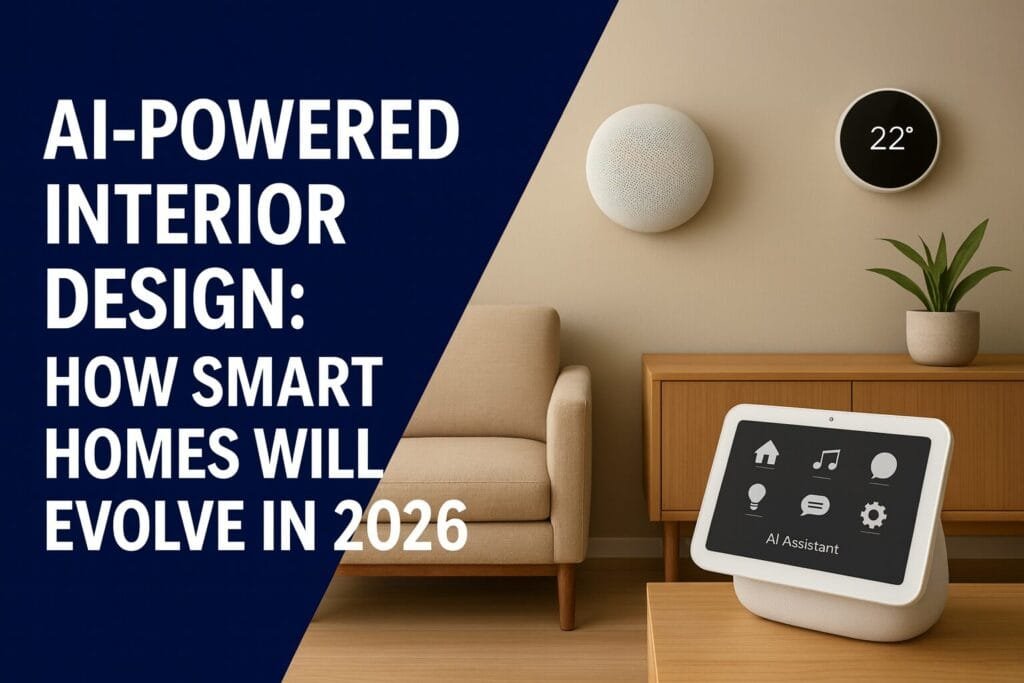
The shift to AI-powered design is not about replacing human creativity; on the contrary, it amplifies what talented designers can do by handling repetitive tasks and giving insights into analytics. Thus, interior design professionals can spend much more of their time with the creative side of their work.
Understanding AI Integration in Modern Interior Design
Artificial intelligence applications in interior design run the gamut from simple recommendation engines to sophisticated spatial analysis tools. These systems can process thousands of design examples in a matter of seconds. They identify patterns that might go unnoticed by human designers because of the volume of information. Machine learning algorithms analyze color combinations, material pairings, and spatial arrangements that have been successful throughout history.
The Best Interior Designer in Delhi NCR now has access to tools that can simulate how natural light will interact with various paint colors throughout the day. These tools take into consideration a specific geographical location and seasonal variations particular to the Delhi region. AI can predict how furniture arrangements are going to impact traffic flow through rooms. It can even make suggestions for modification considering the daily routine of the household members.
Smart Materials and Adaptive Surfaces
But perhaps one of the most exciting developments to come from 2026 is that of smart materials-ones capable of both perceiving changes around them and reacting accordingly. These materials don’t react; they adapt, altering their properties in direct response to real-time information. Envision walls whose color temperature shifts to reinforce your circadian rhythm. Consider floors whose relative hardness changes when they detect that you’re walking upon them barefoot.
These innovations have gradually started to become available through established interior design firms in Delhi NCR. Rishabh Designs & Interior provides budget packages from reasonable amounts for small homes and incorporates some of these emerging technologies. Smart glass that changes from transparent to opaque, depending on privacy needs, is no more science fiction but a standard recommendation for modern residential projects.
Personalization by means of Behavioral Learning
Traditional interior design relied heavily on initial consultations and style questionnaires. Homeowners would describe their preferences in words, usually finding it hard to express precisely what they wanted. The designer would interpret these descriptions and create concepts based on that interpretation. Although effective, this often meant a disconnect could occur between expectation and reality.
Today, AI-powered systems track how residents actually use their spaces over time. These systems note which rooms get used most frequently and during what times. They notice if certain furniture configurations are serving as choke points or facilitating good flow. Over weeks and months, the system builds a comprehensive understanding of living patterns. It can then suggest modifications based on observed behaviors rather than stated preferences.
Voice-Activated Environmental Control
Voice control has come a long way from simple commands with earlier smart home systems. In 2026, natural language processing enables homeowners to speak to their environments conversationally. You don’t have to remember specific command phrases. You can simply state what you want in everyday language, and the system understands context and nuance.
When you say you’re feeling cold, the system doesn’t just adjust the temperature. It considers factors like humidity levels, air circulation, and even the thermal properties of your clothes based on visual recognition. The Best Interior Designer in Delhi NCR integrates these systems into design plans right from the conceptualizing stage. Budget living room makeover designers in Delhi NCR, such as Rishabh Designs & Interior, are, therefore, making these technologies more accessible even for mid-range renovation projects.
## Predictive Maintenance and Resource Optimization
Smart homes in 2026 don’t wait for things to break before alerting their residents. AI systems continuously monitor the health of appliances, HVAC components, and structural elements to predict when maintenance will be required based on usage patterns and performance degradation. This proactive approach saves money and prevents the inconvenience of unexpected failures.
Energy optimization has become incredibly sophisticated: the system learns your schedule and your preferences over time, so it pre-conditions spaces before you would normally use them, rather than waiting for a manual adjustment. And during those periods when the rooms are unoccupied, the systems automatically adjust to energy-saving modes without compromising the immediate responsiveness you expect when you return.
The Role of Augmented Reality in Design Visualization
Augmented reality has changed how clients experience proposed designs before implementation begins. Instead of looking at flat renderings or small-scale models, homeowners can now walk through virtual representations of their redesigned spaces. They see exactly how different furniture pieces will look in actual proportions within their existing rooms. They experiment with various color schemes simply by looking at their walls through AR-enabled devices.
This technology has been of special value for commercial interior design projects. The best interior design firms in Delhi NCR use AR to help business clients visualize how office layouts will impact employee collaboration and workflow. Established businesses, like Dezine Innovation in the region, integrate these visualization tools into their standard design process. This reduces the uncertainty that normally caused revision delays and budget overruns.
Biophilic Design Enhanced by Smart Systems
The integration of nature into interior spaces has gained immense momentum. Studies evidence that exposure to natural elements enhances mental health, productivity, and wellbeing. Smart systems in 2026 will take biophilic design to unprecedented levels, as automated plant care systems monitor the soil moisture, nutrient levels, and light exposure of an indoor garden and automatically adjust watering schedules and supplemental lighting.
Living walls have transcended from simple decoration to intelligent ecosystems. Sensors detect which plants are thriving and which are in stress. Conditions are adjusted for different zones within the same installation. This is how a variety of plant species can successfully coexist. Air quality monitoring is integrated with such systems to maximize the purifying benefits provided by plants.
Context-Aware Lighting Systems
Good lighting design has always been essential to both the aesthetics and functionality of interiors. By 2026, however, lighting systems have reached a contextual awareness previously unimaginable even a few years earlier. They don’t simply dim or brighten on schedule; they understand what’s happening in each room and adjust accordingly. When it detects you are reading, the system provides focused task lighting at appropriate levels. When it detects you’re watching television, it creates ambient lighting that reduces screen glare without plunging the room into darkness.
Circadian lighting systems are in tune with natural daylight patterns, automatically changing color temperature throughout the day. Morning light is cooler and brighter to increase alertness; evening light is warmer to facilitate natural melatonin production. The **Best Interior Designer in Delhi NCR** applies these principles of circadian lighting into residential projects and acknowledges how it directly affects the quality of sleep and a person’s health in general.
Acoustic Optimization via AI Analysis
Sound quality within our living spaces is often an afterthought during the design process, but acoustic comfort can deeply influence our experiences inside the home. By 2026, AI analyzes the acoustic properties of rooms through dimensional assessment, surface materials, and furnishing arrangements to identify areas in the room where sound bounces excessively or ‘dead zones’ where conversation becomes difficult.
Smart acoustic panels will have their absorption properties change dynamically, depending on how a room is currently being used. If one is having a dinner party, they reduce reverberation to make conversation easier; if one is listening solo, they optimize for music playback. These adaptive acoustic systems greatly benefit home theater installations. The spatial audio experience will change based on where viewers are sitting.
Data Security and Privacy in Smart Homes
As homes have become increasingly connected and intelligent, security considerations have shifted to the fore. Every sensor, camera, and smart device becomes a point of ingress for malicious actors. Responsible interior design firms recognize this reality, joining forces with cybersecurity specialists to ensure that smart home installations are properly secured.
In 2026, security-aware design is about more than the installation of firewalls and encryption. That means thinking about which devices really need internet connectivity and which can function on isolated local networks. Privacy settings are set up at installation rather than being left to the whims of the homeowners afterwards. The top interior designers in Delhi NCR advise their clients on such aspects of security. They assist homeowners in making informed decisions regarding the trade-offs between convenience and privacy.
Integrating Traditional Craftsmanship with Modern Technology
Yet all these technological advances are incorporated, and the most successful interior design projects in 2026 do not abandon traditional craftsmanship; rather, they find harmonious ways to integrate timeless techniques with state-of-the-art innovation. Handcrafted furniture pieces coexist in beauty with smart lighting systems. Artisanal textiles complement temperature-regulating wall panels.
Firms like Rishabh Designs & Interior have built their reputation on this balanced approach. They understand that technology should enhance and not overshadow the warmth and character that make a house feel like home. Their team works on everything from budget-friendly home décor to more elaborate projects, with projects that feel both current and timeless.
DEMOCRATIZATION OF LUXURY DESIGN
One of the most striking things about the trend in 2026 is how technology has democratized sophisticated design. AI-powered design features that were previously available only to high-end firms are fast becoming standard parts of mainstream design software. This democratization does not lessen the value of professional expertise; rather, it raises the baseline quality of what all designers can provide.
What was earlier considered a luxury offering is now possible at budget rates for interior designers in Delhi NCR. Rishabh Designs & Interior specializes in economical services that may include space-saving solutions for small apartments. Their accessible approach demonstrates how technology enables quality design irrespective of project scale or budget constraints.
Commercial Applications and Office Evolution
The same principles working to revolutionize residential design have a comparable impact in commercial contexts. The office spaces of the future are reconceptualized as adaptive ecologies serving varied use cases for their occupants. Conference rooms automatically adjust lighting, temperature, and acoustic properties based on the type of meeting detected. Collaboration spaces turn into quiet areas of focus with simple adjustments using AI systems for management.
The best interior designers in Delhi NCR and Gurgaon realize that commercial projects are quite different, and workplace design can directly affect productivity and employee satisfaction. They create offices where occupancy sensors make sure space utilization is optimized. They create flexible layouts; desk arrangements can be modified with ease as team structures evolve.
Sustainability through Intelligent Resource Management
Environmental sustainability has become a non-negotiable aspect of responsible design. Smart home systems contribute greatly to lessening the environmental impact. They optimize energy consumption, not only by operating devices efficiently but also with predictive analysis. Systems predict when solar panels will create excess power and schedule power-hungry tasks accordingly.
Water conservation systems monitor usage patterns and detect leaks in nearly real time. They also adjust irrigation schedules for landscaping based on weather forecasts and soil moisture readings. Interior design firms positioning themselves as industry leaders recognize sustainability as both an ethical imperative and a practical concern for clients facing rising utility costs.
The Human Factor Remains Central
Despite all these technological advances, successful interior design in 2026 still depends on an understanding of human psychology and behavior. Technology provides tools and capabilities, but to design spaces that truly resonate with the people inhabiting them requires empathy and insight. The Best Interior Designer in Delhi NCR combines technological proficiency with deep understanding of how people want to feel in their homes.
Companies like Rishabh Design & Interior, who have survived through the years-2007 onwards-know full well that trends come and go, so they design spaces to adapt to technological upgrades without having to completely renovate every now and then. This strategic foresight safeguards clients’ investments while allowing them to keep up with the times in their homes. ## Looking Ahead: The Next Phase of Evolution As we progress through 2026, this trend in AI-powered interior design is moving toward even smoother integration between physical spaces and digital intelligence. Homes are fast becoming dynamic ecosystems that adapt and continuously evolve; they can learn not just from the immediate household, but from aggregated data across millions of connected homes. At the same time, this improvement of systems through collective intelligence happens via privacy-preserving machine learning, with no compromise to the individual household data. The relationship between homeowners and their living spaces is fundamentally changing. Spaces are no longer static backdrops to daily life; they are active participants which support and enhance the way we live. Finding interior designers who understand this shift and can guide clients through the complexity is increasingly valuable. Choosing the Right Design Partner While finding the **Best Interior Designer in Delhi NCR**, a homeowner should seek firms that show both technical knowledge and design artistry. Check their portfolio regarding the incorporation of smart technologies into past work. Ask how they balance innovation with timeless design principles. Inquire about the partnerships they make with technology providers and their process for keeping up with rapid changes in the field. Rishabh Designs & Interior reflects the client-based philosophy underlying the most successful modern design firms. The firm provides consultations free of charge and transparent quotations for work. Its team operates in both residential and commercial spheres, with the same attention to quality, irrespective of budget. They believe beautiful, functional, intelligent space can be created only when skilled designers have informed clients who are empowered to state their vision. The transformation that interior design is undergoing due to artificial intelligence and smart home technologies makes it one of the most exciting transformations in how we create and experience living spaces. It is 2026, but the journey is not nearing its end; rather, it is a phase when possibilities are accelerating more than ever. For homeowners ready to accept this, it’s of utmost importance to partner with knowledgeable interior design professionals that understand both the potential and practical considerations. Intelligent, adaptive, and more personal than ever, this is where the future of home design is heading.