How AI Interior Assistants Will Transform Home Designing in 2026
Home design is reaching a whole new revolutionary phase. AI is reshaping the way we imagine, plan, and build our living spaces. What is happening now will fundamentally change interior design by 2026. To the homeowners in Delhi NCR who strive for the right blend of technology and traditional expertise, it is essential to understand these changes.
The introduction of AI interior assistants has not replaced human creativity; instead, it enhances the skills of highly qualified designers. While working with the Best Interior Designer in Delhi NCR, customers now get the power of human intuition combined with AI-driven precision. It achieves what was impossible to think about only a few years ago.
Current State of AI in Interior Design
Interior designers globally are embracing artificial intelligence at a fast rate. Recent surveys show that AI adoption among designers tripled in 2025, jumping from nine percent in 2023 to twenty-nine percent. Another twenty percent of designers plan to integrate AI tools in their work during 2026.
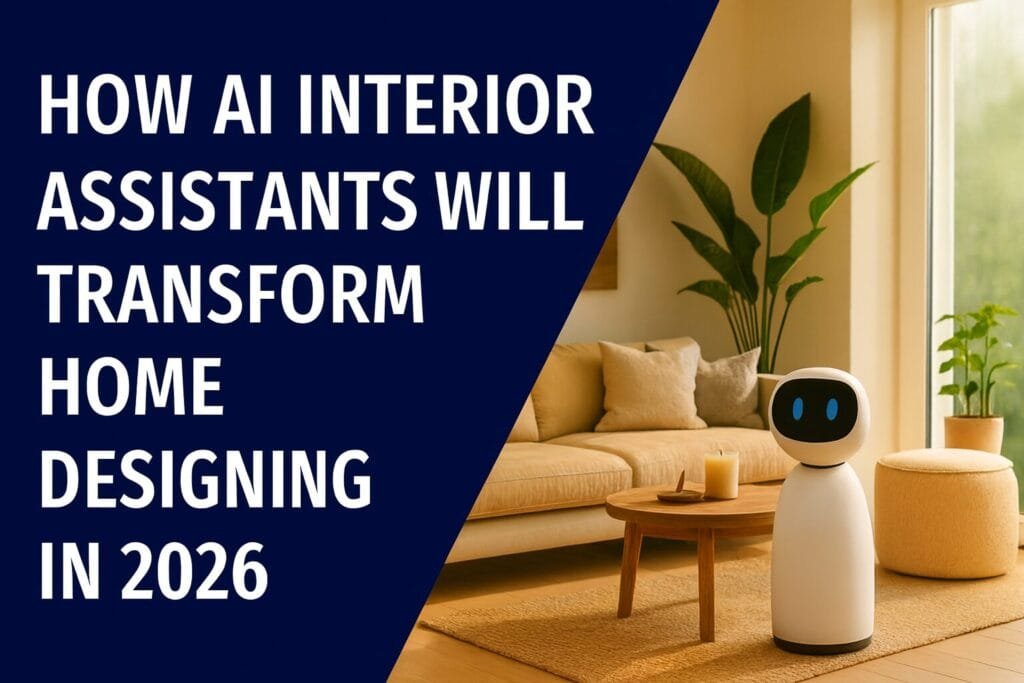
This explosion in adoption reflects the technology’s proven value. Designers are using AI for renderings, presentations, and client visualizations. These tools can produce realistic images in minutes that required hours or days of manual work in the past. Efficiency lets designers explore even more creative options with clients.
AI interior design platforms now offer sophisticated capabilities. Tools like Planner 5D and Interior AI create photorealistic renders from basic sketches. Homeowners can upload photos of their spaces and see instant redesigns in dozens of styles. It analyzes room layout, lighting conditions, and personal preferences to come up with custom recommendations.
How AI Assistants Work in Practice
Modern AI interior assistants operate using intuitive interfaces: the users upload photos of their existing spaces or create floor plans from scratch; the AI analyzes spatial data, furniture placement, and design patterns. Within seconds, it generates multiple design concepts.
The technology considers factors that could be easily overlooked by human designers. AI algorithms run the calculations for optimal furniture arrangements that maximize usable space. They suggest color palettes that best complement natural lighting. They even predict how different materials will appear under various lighting conditions throughout the day.
Smart AI platforms learn through user feedback and industry trends. With each interaction, the system gets smarter and more accurate. The AI adjusts its future recommendations whenever users reject certain suggestions. This continuous learning keeps recommendations up to date with changing design preferences.
Rishabh Designs & Interior, known as the Best Interior Designer in Delhi NCR, brings alive the combination of traditional expertise and state-of-the-art technology. Their method combines decades of design experience with the latest visualization software. Clients will get both the personal touch of bespoke services and the exactitude of AI-assisted planning.
Personalization Unleashed Like Never Before
AI-powered interior assistants are perfect for creating highly personalized experiences. The technology analyzes design preferences based on previous interactions, images saved, and requirements stated. Every recommendation will be personalized according to individual tastes and lifestyles.
Advanced platforms incorporate real product imagery into AI-generated rooms. That means instead of generic placeholders, clients see actual furniture pieces available for purchase. The integration closes the gap between visualization and reality. What you see is really what you can buy.
The personalization encompasses cultural inclinations and regional tastes. In the diverse market of India, AI tools now understand local design sensibilities. They incorporate traditional elements such as jali work, ethnic textiles, and regional color preferences. This cultural awareness makes AI assistance relevant for Indian homeowners.
Speed and Efficiency Revolution
Traditional processes in interior design involve several revision cycles. Designers conceptualize designs, present them to clients, garner feedback from them, and revise accordingly. Each cycle may take days or even weeks. AI compresses this timeline dramatically.
Instant visualization makes collaboration in real-time possible: during consultations, clients and designers explore options together. They change colors, switch furniture, and try different layouts on the spot. When everyone sees the results instantly, decisions go quicker.
This speed benefits both designers and clients. Designers complete projects faster and serve more clients. Homeowners move into their dream spaces sooner. This efficiency doesn’t mean a sacrifice in quality; rather, it allows more time to refine and perfect it.
Cost Implications and Accessibility
AI-powered interior design tools democratize access to professional interior design services. Basic platforms offer free tiers with limited functionalities, while premium subscriptions stand from fourteen to ninety-nine dollars per month. For this reason, design assistance has become much more affordable for bigger masses.
However, complex projects cannot be fully managed by AI tools. The Best Interior Designer in Delhi NCR merges AI capabilities with unmatched human skills: emotional intelligence, artistic vision, and personalized relationships with clients are the distinctly human assets that no AI technology can replace.
Rishabh Designs & Interior provides budget packages for small homes, starting from one point five lakh rupees. Their modus operandi proves that professional skills remain within reach while merging with advanced technology. Comprehensive services are given to the clients by amalgamating traditional craftsmanship with digital novelty.
Advantages of the Hybrid Model
The most successful interior design approaches in 2026 will be those that blend human creativity with AI. Designers use AI for tasks such as initial concepts and quick renderings. They save their skills for interpreting client emotions, understanding lifestyle nuances, and bringing unique personality to a space.
This model generates better outputs. It automates repetitive tasks and technical calculations with the help of AI, while human designers concentrate on creative vision and client relationship building. The combination produces designs that are technically optimized and emotionally resonant.
Professional designers appreciate AI as a collaborative tool, rather than a competitor. They apply AI in their workflow efficiency, research, and early conceptual ideation. The technology assists with document drafting and presentation creation. Such applications liberate designers to concentrate on what they do best.
Virtual Reality and Immersive Experiences
Virtual reality capability is increasingly being incorporated into AI interior assistants. Their clients wear VR headsets and walk through their future homes before any construction begins, feeling the room proportions, lighting effects, and spatial relationships in person.
This immersive preview eliminates costly mistakes. Clients find out whether their favorite furniture configuration really works in practice. They notice potential issues with traffic flow or storage that may not be sufficient. These insights lead to better final decisions.
Augmented reality features complementary to VR experiences let users point smartphones at empty rooms and see real-time overlaid furniture. They judge if the sofa will fit perfectly, or if the painting hangs at the right height-a very practical application and one that seamlessly bridges imagination and reality.
Selection and Visualization of Materials
Choosing materials remains challenging during traditional design processes. Fabric swatches and paint chips can provide very limited perspective. AI assistants show what entire rooms would look like with various types of materials applied.
The technology shows flooring options in a realistic way. Clients can see how Italian marble looks compared to engineered wood in their specific lighting. They can visualize curtain fabrics across different times of day. These comprehensive views support confident material decisions.
AI platforms also recommend material combinations that work well together. They identify the textures and finishes that complement each other. This provides great value for clients who are not design-trained. The recommendations ensure cohesive and professional-looking results.
Intelligency of Space Optimizing
Most Indian homes suffer from space constraints. For every square foot, optimization becomes necessary. AI assistants do this with panache through data analysis.
The technology calculates the ideal furniture dimensions for certain rooms. It indicates layouts that will save traffic flow but maximize seating or storage. Such recommendations consider several variables all at once, which is quite hard for human designers to calculate manually.
Smart AI tools offer innovative solutions for awkward spaces, identifying opportunities for built-in storage or multifunctional furniture. Many of these suggestions have the potential to reveal opportunities that might otherwise have been overlooked by the clients and designers themselves.
Trend Forecasting and Evolution of Style
AI platforms review millions of design data from around the world. They discover emerging trends before they go mainstream, thus helping designers be ahead of the trend through their predictive capability.
Current data indicates maximalism and eclecticism as the dominant trends in 2026 design. Chocolate brown comes up as the very top trending color. Vintage and antique items from the 1920s through 1950s move into high demand. AI assistants can automatically include this information when making suggestions.
The technology also adapts to individual style evolution. As a client’s preferences mature, so too do the AI suggestions. This dynamic adaptation ensures recommendations remain relevant throughout long-term projects.
Integration with Smart Home Technology
AI interior assistants increasingly connect with Internet of Things devices. They work in concert with smart lighting, thermostats, and security systems for cohesive living environments that are tech-savvy.
Lighting scenes can be programmed by designers to complement interior schemes. Smart blinds automatically adjust to protect furniture from harsh sunlight. These technological integrations enhance both the aesthetic and functional qualities.
The Best Interior Designer in Delhi NCR knows well how technology enhances traditional design. Rishabh Designs & Interior creates spaces that accommodate modern conveniences without compromising aesthetic vision. Their projects blend timeless design principles with contemporary smart home features.
Multilingual and Cultural Adaptation
The peculiarity of the linguistic and cultural diversity in India brings new design challenges. AI assistants now support multiple Indian languages, and clients can simply communicate their requirements in Hindi, Tamil, Telugu, or whichever language they consider preferable. This accessibility opens design services to wider audiences.
Cultural adaptation goes beyond language. AI platforms understand regional design preferences and traditional aesthetics. They suggest elements that resonate with local sensibilities while incorporating modern innovations.
This cultural intelligence proves particularly valuable in diverse markets such as Delhi NCR. The region is a beautiful mix of traditional North Indian aesthetics and also cosmopolitan international influences. AI tools navigate this complexity without compromising on cultural authenticity.
Overview Environmental sustainability features
Value propagates with sustainable design among environmentally-sensitive homeowners. AI assistants incorporate in their recommendations sustainability analysis. They will actually suggest eco-friendly materials and energy-efficient layouts.
The technology calculates how different design choices impact energy consumption. It recommends window placements that maximize natural light. It suggests materials with lower environmental footprints. These features align design beauty with environmental responsibility.
Professional designers find it valuable how AI quantifies sustainability benefits. They present clients with data-driven environmental impact assessments. This information helps them make informed decisions about green design options.
The Learning Curve and Adoption
Most homeowners are still wary of AI design tools because they assume these tools must be overwhelmingly complicated to use. That assumption is wrong, as modern platforms are designed with the user interface in mind. Most require no technical knowledge or design training.
Drag-and-drop functionality makes experimentation easy. Guided prompts help users articulate their preferences. Automated suggestions reduce decision paralysis. With such features, AI design tools become accessible to all.
Professional designers face low learning curves with specialist tools. Platforms built for industry professionals integrate into current workflows, rather than displacing them.
Quality and Accuracy Considerations
Generally, AI-generated designs prove accurate in aesthetics and layout, but they cannot fully replicate the nuanced understanding human designers bring to a project. For complex spatial challenges, human expertise is still essential.
The sensory and emotional aspects of design remain human domains. Scale, proportion, and materiality require lived experience to judge properly. AI can assist but cannot replace intuition and experience of being in physical space.
This limitation explains why combining AI tools with professional designers delivers the best results. The Best Interior Designer in Delhi NCR uses AI in enhancing efficiency while applying irreplaceable human judgment to critical decisions.
Commercial Applications Beyond Homes
AI interior assistants now serve commercial spaces with efficacy: restaurants, offices, and retail stores all benefit from its quick visualization and efficient planning. This technology adapts just as well to commercial requirements as to residential ones.
Rishabh Designs & Interior demonstrates this versatility through projects for major brands. Their portfolio comprises Zomato, Burger King, KFC, Domino’s Pizza, Costa Coffee, and many more. These commercial projects epitomize how professional expertise elevates AI-assisted design to new, unparalleled heights for business environments.
Commercial customers especially value the speed of AI. Restaurants that open on tight schedules appreciate rapid design iterations; retail stores testing new concepts make the most of quickly visualizing multiple options.
Future Developments on the Horizon
AI interior design technology is continuously and rapidly changing. Other developments in the near future guarantee even more intelligent capabilities: predictive analysis will more accurately forecast design trends, machine learning will deliver increasingly personalized recommendations.
AI-based video tools will let clients walk through their future home by generating video walkthroughs. Voice-enabled AI assistants will accept spoken design preferences. The design process will be even more intuitive and accessible with these innovations.
As integration between AI platforms and manufacturing begins, production will be streamlined. A custom furniture design created using AI tools will directly feed into the manufacturing system. This kind of end-to-end digital workflow reduces costs and delivery times.
Investment Considerations for Homeowners
Whether a project requires the use of AI design tools or the hiring of professional designers depends on its complexity. Simple refreshes might work just fine with AI platforms alone, while comprehensive home renovations benefit from professional expertise supported by AI capabilities.
This is also a matter of budget. AI design platforms are more affordable at their point of entry, whereas professional designers justify higher investments with full-service work for the most complex projects.
The smartest approach normally combines both. Use AI tools for preliminary exploration and inspiration. Employ professional designers to sharpen the concept and ensure perfection in execution. This hybrid strategy creates the most value while managing costs.
The Role of Human Touch
Despite technological advances, emotional intelligence remains uniquely human. Empathy is necessary to understand how families live, what makes them comfortable, and what reflects their identity. AI cannot truly understand such deeply personal factors.
Great designers read between the lines in client communications. They decode body language during presentations. They feel the hesitation or enthusiasm that drives revisions. These human soft skills are irreplaceable irrespective of AI functionalities.
The success of Rishabh Designs & Interior lies in customer-oriented service. They develop spaces for work and leisure that are attractive and convenient. Their author supervises each detail personally. The human touch in this makes good designs turn into spaces which will remind one of home.
2026 Implementation Strategy
Homeowners renovating in 2026 should use AI tools to their strategic advantage. Use free platforms to see what’s possible and to firm up preferences. Document likes and dislikes, invaluable self-discovery before engaging professional designers.
When ready to get serious about planning, consult with designers utilizing AI capabilities. Inquire about how they incorporate technology into their process. The Best Interior Designer in Delhi NCR will show how they merge digital tools with traditional craftsmanship. Expect collaborative sessions with real-time alternatives provided by AI. Be prepared to freely experiment without the fear of wasting time. Modern design processes encourage exploration. Technology makes experimentation affordable and fast. Conclusion AI interior assistants will revolutionize the way one thinks about home designing. The technology offers an unprecedented level of personalization, efficiency, and accessibility. By 2026, AI will be standard in most design processes rather than experimental novelty. But rather than replacing human designers with artificial intelligence, the latter enhances the former. The best projects meld technological capability and human creativity, along with emotional intelligence. This partnership delivers results superior to either approach alone. The way ahead is fairly clear for Delhi NCR homeowners who aspire for great interiors. Use AI for exploration and visualization. Join hands with the Best Interior Designer in Delhi NCR to get the expertise which technology cannot provide. Rishabh Designs & Interior embodies this well-balanced approach. Their commitment to fusing creativity, comfort, and functionality does not change. Their methods simply evolve to accommodate the powerful new tools. It’s a forward-thinking philosophy that makes sure clients also get timeless design principles along with state-of-the-art capabilities. The future of interior design is neither solely human nor completely automated. It’s a partnership where technology amplifies human creativity. Homeowners who understand this balance will create spaces that are beautiful, functional, and uniquely theirs. The transformation is here. The only question is how quickly you’ll embrace it.